Samples of frustrations Producing Partner can help eliminate
Producing Partner Defined
Producing Partner is essentially a system of systems joined together in the background to organize, manage and automate recurring work. It brings together research, preparation, critiques, performance development, marketing, assets and follow-up, then connects those activities into processes that require less time and effort to manage.
Producing Partner uses a carefully selected toolset, including AI, to support the work. Its workflows are designed around the needs of creative and production professionals. Systems handle work where systems are useful, including recurring tasks that can be handled automatically. Human judgment, talent and experience remain central where they matter.
What could this look like for different professionals?
A Producing Partner can be shaped for specific roles and even around individual people and the way they work.
Producing Partner at Work
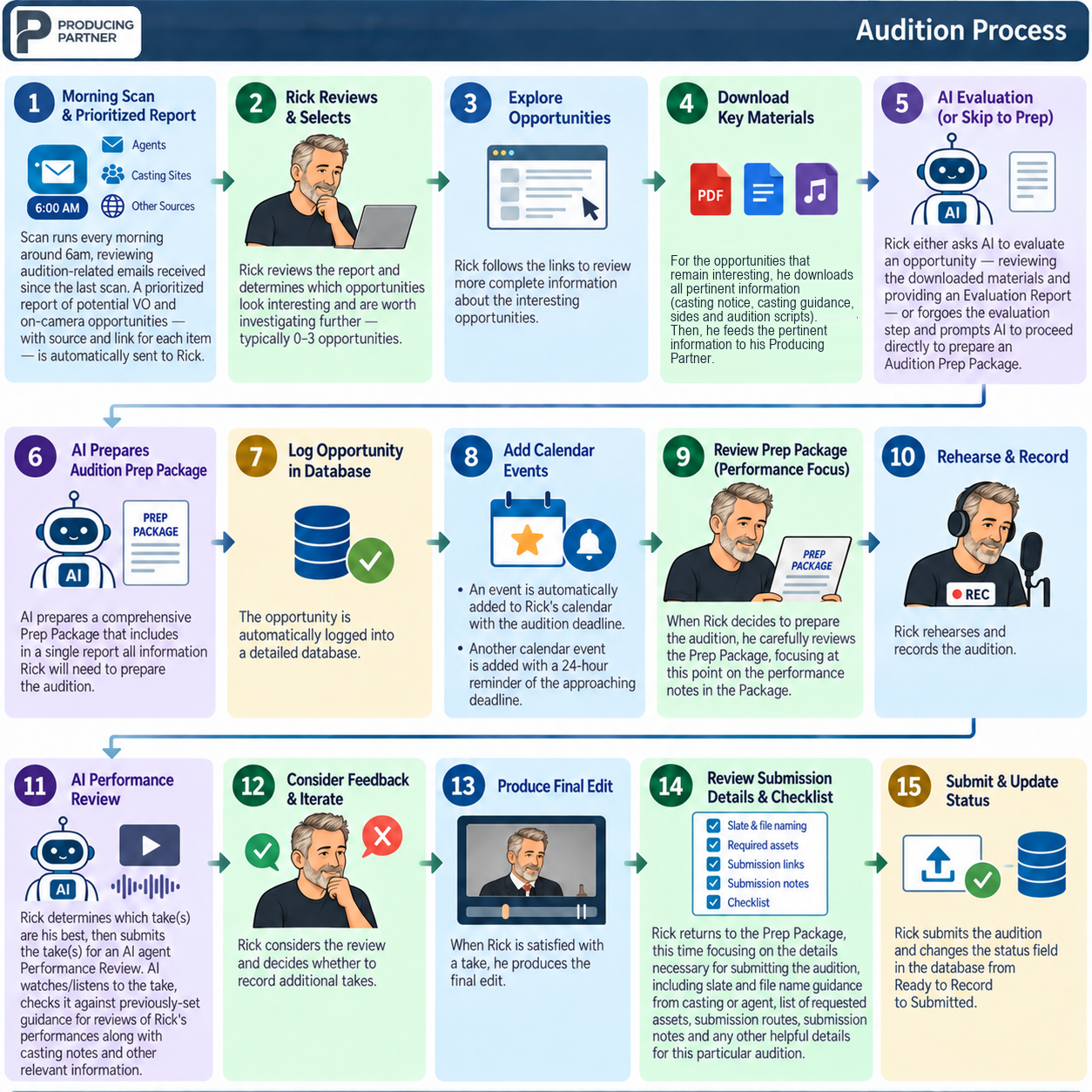
Here is just one example of how Rick uses his Producing Partner, in this case for better auditions. An audition opportunity moves from evaluation to preparation to performance to submission to lessons learned. Along the way, time is saved and frustrations are avoided, leaving more attention for the judgment, choices and performance work that help him respond to casting’s wishes, add his own touches and put his best work forward.
Beyond Audition Preparation
Rick also uses his Producing Partner for other work…
- Job preparation — Thorough Job Prep Packages carrying forward reporting details, requirements, project context, preparation notes and other information needed for the work.
- Clip catalog — Management of a growing catalog of about 150 performance clips, with analysis and metadata that make useful material easier to find and reuse.
- Audition-specific demos — Creation of demos assembled and tailored to the audition or opportunity at hand.
- Jobs and resumes — Documentation of hired jobs and credits, connected to an automated resume builder.
- Performance Lanes — Analysis, definition and communication of the performance lanes that best describe demonstrated work.
- Performance Profiles — Creation and maintenance of reusable profiles that preserve performance findings and positioning.
- Professional relationships and expansion — Structured development of talent-agent representation and production-partner relationships.
Questions About Producing Partner
What is a Producing Partner?
A Producing Partner is a technology-enabled system built on an operating framework of more than 1,000 interconnected elements, presented in a user-friendly way to automate and manage the repetitive processes associated with on-camera and voiceover performance and production.
That operating framework enables layers to be shaped around the work at hand, different roles, and even individual users and their personal workflows.
What does it actually do?
What a Producing Partner does will vary by person and role.
It helps organize and carry out selected recurring work. Examples include audition and job prep; research; development and management of clips, reels, demos and other assets that show your chops; job tracking and resume-building; performance critiques; requirements writing; project management; deadline reminders; and much more.
As you work with it, your Producing Partner learns how you like to work and can make increasingly useful suggestions to strengthen routines, improve efficiency and reduce repetitive effort.
How is this different from simply asking AI to do things?
The primary distinction is the operating framework made up of the 1,000+ interconnected elements. An AI conversation can conduct research or help with an individual task, usually quite well.
Producing Partner may use AI, but it is designed to support the continuing work of a role or individual over time.
Producing Partner’s operating framework guides those tasks by drawing on established instructions, prior decisions, reusable knowledge, databases and other records, and defined processes rather than treating each request as a blank slate.
Is Producing Partner an AI agent?
An AI agent is a system that can use AI to carry out tasks, make decisions within defined rules, and take actions on a user’s behalf.
Producing Partner is not one agent carrying out the work. It uses agents and other tools within a larger system that provides the instructions, context, continuity, and human decision points that guide the work. That larger system is the operating framework. A Producing Partner can be shaped around particular work or roles. Your Producing Partner is shaped around you and the way you work.
Does AI make the creative decisions?
No.
AI can help research, organize, analyze, compare, prepare, check, and carry out routine processes, but creative judgment remains with the professional.
That boundary is deliberate. Producing Partner includes built-in functions that stop or hand off tasks when human thought, judgment, or action is needed for the task.
Why would a creative professional want AI involved?
They may not want AI involved in the creative act at all. Its useful role may be in handling or assisting with the necessary work around those acts, leaving more time and attention for the work where human judgment, imagination, talent, experience, and problem-solving matter most.
Does Producing Partner replace assistants, producers, agents, or other professionals?
No.
In fact, Producing Partner can make their work more effective by improving the information, organization, continuity, and preparation surrounding the work they do. It can also make collaboration with other people better informed.
The point is to let process handle the work it can handle well, while people focus their time and attention where judgment, talent, experience, relationships, and expertise matter most.
What happens to judgment, instinct, and relationships?
They remain human responsibilities.
A system cannot substitute for taste, trust, instinct, lived experience, or the judgment that develops between people. It can organize information, preserve history, surface patterns, and prepare choices.
Producing Partner makes those human capabilities easier to exercise, not attempt to replace them.
Would someone else's Producing Partner look like this one?
Probably not. The existing Producing Partner grew from one person's work across on-camera acting, voiceover, audiobooks, producing, and related activity.
A producer, director, casting professional, agent, or crew professional would have different needs. As well, needs would vary from individual to individual.
What is transferable is the approach: customize the system around the work, rather than forcing the work into a predetermined system.
Do you have to be proficient with AI to use Producing Partner?
No.
You work with a Producing Partner through the language, decisions, materials, and routines of your own work.
The AI, tools, instructions, and processes operate within the Producing Partner. You do not need to understand how each of them works in order to use the system effectively.
How should I determine whether my work is a good candidate for a system like this?
Ask yourself these questions:
- What work recurs?
- What is frustrating?
- What should be remembered?
- What can be standardized?
- What requires human judgment?
- What should happen automatically, and what should always come back to a person?
The answers help distinguish work that benefits from a repeatable system from work that should remain situational, relational, or creative.
Is Producing Partner a product?
Not at this point.
Producing Partner began as a system built to support one person's work. As it grew, it became clear that much of the underlying operating framework could be adapted for other creative and production professionals, their roles, and their individual workflows.
We are now selectively showing it to others and beginning to identify people in our network who may want to put parts of a Producing Partner to work for themselves.
Where that leads is still open. A product may eventually be one result, but the next step is to learn from real use before deciding what Producing Partner should become.
Why are you showing it to people now?
Producing Partner reached a point where it seemed worth sharing beyond the work it was originally built to support.
At this stage of my career and life, I am interested in sharing what I have learned, learning from other professionals, and helping people think more practically about how AI can support their work—especially when it is part of a larger system designed around context, process, continuity, and human judgment.
That may mean showing people what I have built, helping a few put parts of a Producing Partner to work for themselves, or having conversations and sessions with targeted groups about ways they can begin using AI in their own work.
The purpose is not to sell Producing Partner. It is to share what has been learned, see what others can do with it, and learn where those conversations lead.
Rick Wimberly
Rick Wimberly is an actor, voice actor and producer who developed Producing Partner to manage the growing body of work surrounding his own creative career. What began as a practical solution for his work has evolved into a working system spanning opportunities, auditions, jobs, relationships, career assets, producing and other recurring professional processes.
rick@rickwimberlyactor.com · rickwimberlyactor.comBackstageLinkedIn